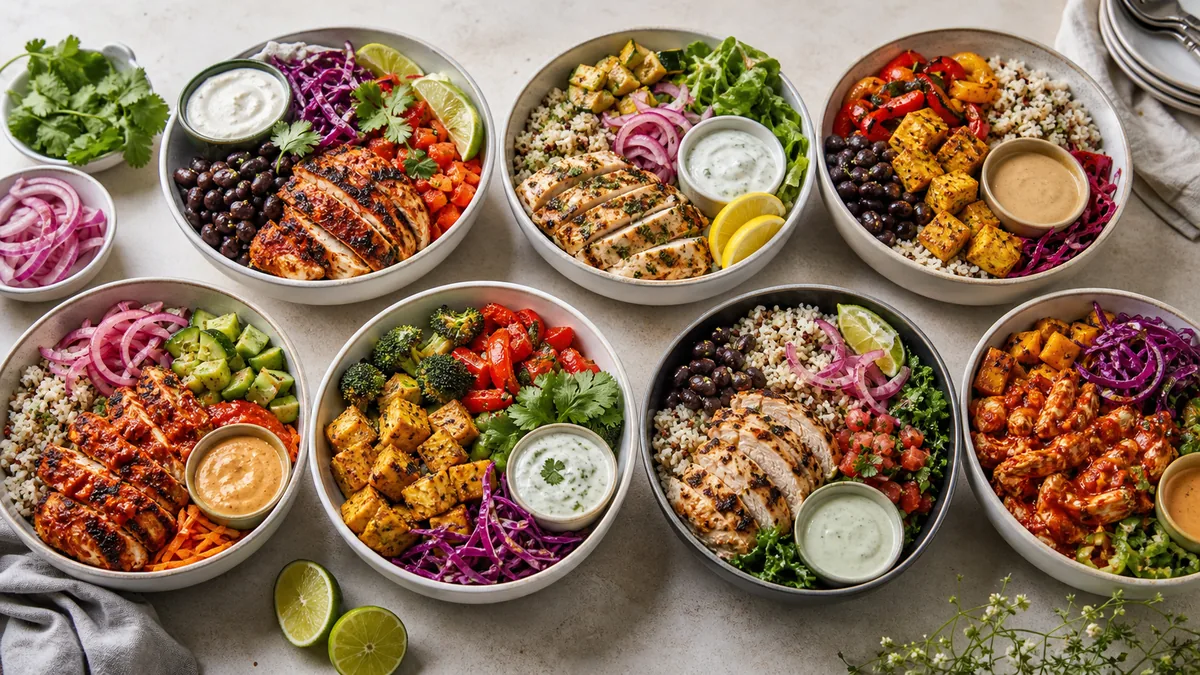
How to Meal Prep for the Week: A 90-Minute Sunday Plan
The order of operations matters more than the recipes. Here is the exact 90-minute sequence that gets five lunches and three dinners into the fridge.
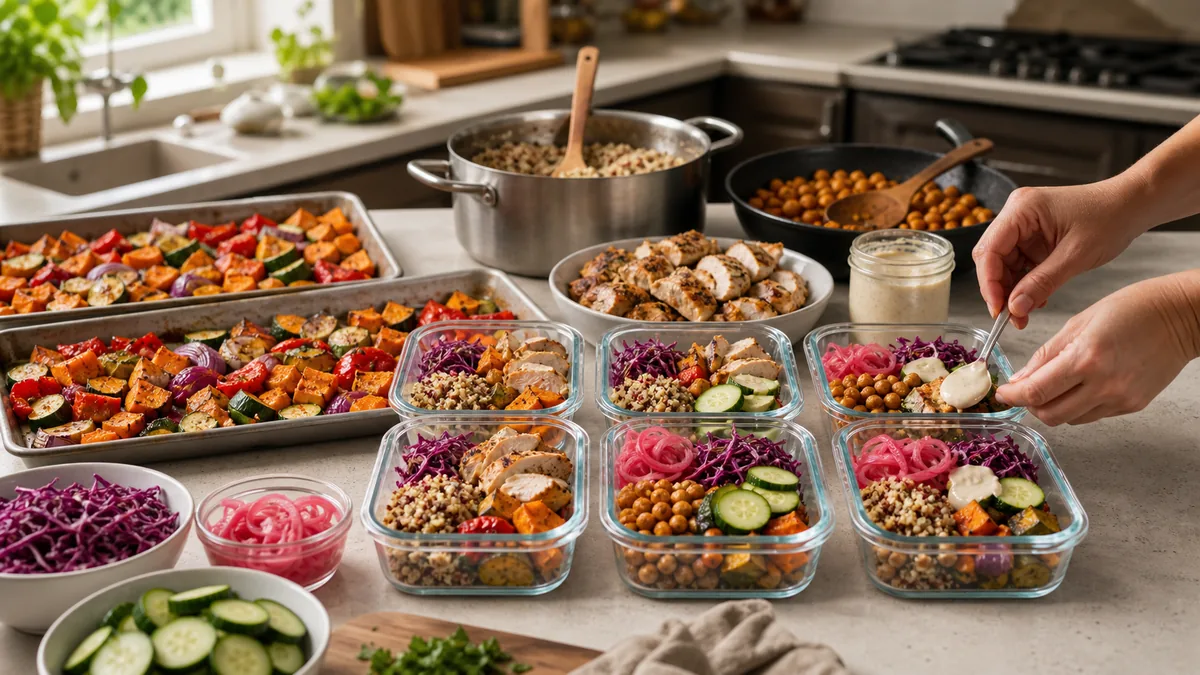
Most people quit meal prep in week three. Not because it stopped working, but because Sunday started eating four hours and the food got boring by Wednesday.
Both problems have the same cause: no order of operations. You cook one recipe, wash up, cook the next, wash up again. A restaurant kitchen would never do that, and neither should you.
This is the sequence that gets five lunches and three dinner components into the fridge in about 90 minutes of actual work — most of which is waiting.
- total
- 90 min
- hands on
- 35 min
- portions
- 8
- fridge
- 4 days
#Why does meal prep take three hours instead of ninety minutes?
#What should you start cooking first?
Your oven and your rice cooker do not need supervision. Your knife does. So everything that goes in the oven or on a low simmer goes on first, and you do the chopping while it runs.
That single reorder is the difference between a 90-minute session and a three-hour one.
#Does the recipe matter more than the order?
No — the order matters more, and it is not close. Almost every meal prep guide is a list of recipes. Recipes are the easy part — you can find a good one in thirty seconds. What nobody writes down is the sequence, which is the thing that decides whether Sunday costs you 90 minutes or three hours.
#What does a 90-minute meal prep session look like?
- 0–10 min Get the heat goingOven on, two trays in, grains simmering
- 10–30 min Cook two proteinsOne roasted, one pan-cooked. Your only busy block
- 30–45 min One sauce, one crunchy thingThe two elements that stop it tasting like leftovers
- 45–70 min Cool on traysShallow, uncovered, into the fridge inside an hour
- 70–90 min Label and stackDate on every lid, oldest at the front
#Minutes 0–10: what goes on the heat first?
#Which jobs cook without you watching them?
Oven to 220°C / 425°F. While it heats:
- Tip two trays of chopped vegetables into the oven the moment it is up to temperature. Root veg on one, quicker veg like peppers and courgette on the other.
- Rice, quinoa or another grain into the pot. Lid on, timer set.
- If you are cooking a protein that needs a long braise, it goes on now too.
You have now committed roughly 45 minutes of cooking that requires nothing from you.
#Minutes 10–30: how many proteins should you cook?
#Why cook two proteins instead of one?
Because one protein is what makes Wednesday boring, and a second one costs you almost no extra time.
This is your only genuinely active block. Season and cook two proteins, not one — this is what stops Wednesday boredom.
A good default pairing is one roasted (chicken thighs, salmon, tofu) and one pan-cooked (spiced mince, chickpeas, prawns). Different textures, different cuisines, same shopping trip.
#Should you undercook protein for meal prep?
#Minutes 30–45: what stops prepped food tasting like leftovers?
The two elements that separate meal prep from sad leftovers.
#What kind of sauce survives four days?
Something loud enough to survive four days. A yoghurt-tahini-lemon-garlic blend, a peanut-lime-soy dressing, or a jar of harissa loosened with olive oil. Keep it in a separate small container — the moment sauce touches grain, a clock starts.
#What should you add raw?
Shredded red cabbage, quick-pickled onions, cucumber. Added at the last minute, it makes a reheated bowl taste assembled rather than reheated. It is thirty seconds of work and it does more for the food than any recipe upgrade.
#Minutes 45–70: how should you cool cooked food?
#Why does cooling matter more than anything else?
Because bacterial growth is geometric rather than steady, so the time spent warm compounds. This is the step people skip and it is the one that actually matters, and the reason is arithmetic rather than fussiness. Bacterial populations grow geometrically, not steadily: a batch that spends three hours drifting down through room temperature does not spoil slightly faster than one that spent forty minutes, it spoils on a completely different curve. That is why every food safety authority frames the rule as a clock rather than a temperature — the total time spent warm is what you are actually managing.
- Spread it out Shallow tray, single layer, no stacking
- Leave the lid off Trapped steam keeps food warm and soggy
- Fridge within 2 hours One hour for rice or a warm kitchen
- Back shelf, not the door The door swings between 5°C and 10°C
Hot food in a sealed container steams itself, goes soggy, and sits in the bacterial danger zone for far too long. Spread everything on trays or shallow dishes and get it to room temperature within an hour, then pack and refrigerate.
#Minutes 70–90: how should you label and stack containers?
#What should you write on the lid?
Write the date on every lid. Not the contents — you will recognise those — the date. It is the only way to stop the "is this from last Sunday or the one before" standoff.
#Where in the fridge should each container go?
Stack so the oldest is at the front. Put anything you plan to eat on days four and five in the coldest part of the fridge, which is the back of the bottom shelf, not the door.
#How much food should you make for five days?
#Should you prep components or finished meals?
The most common beginner error is prepping five identical lunches and three identical dinners, which nobody wants to eat.
Prep components instead:
| Component | Quantity for one person, 5 days | Keeps |
|---|---|---|
| Grain (cooked) | 4 cups | 4 days |
| Protein A (roasted) | 500 g raw weight | 3–4 days |
| Protein B (pan) | 400 g raw weight | 3–4 days |
| Roasted vegetables | 2 large trays | 4 days |
| Sauce | 250 ml | 5–7 days |
| Raw crunch | Prep on the day | 2–3 days |
Five lunches from those components can be five different meals: a grain bowl, a wrap, a salad with the protein cold, a stir-fry with fresh noodles, and a tray of nachos. Same shopping, no repetition.
For a full worked example with the shopping list, see our $50 weekly plan.
#What should you never meal prep in advance?
#Which five foods never survive four days?
Some things simply do not survive four days, and prepping them is how you end up throwing food away:
- Dressed salads. Leaves collapse within hours. Prep the leaves and the dressing separately.
- Anything fried. Crispiness is a Sunday-only property.
- Avocado. No trick actually works. Buy them slightly under-ripe and cut them fresh.
- Fish beyond day two. Salmon and white fish are best eaten within 48 hours of cooking.
- Pasta in sauce. It keeps absorbing liquid. Store the sauce separately and the pasta slightly under-cooked.
Our fridge storage guide has the food-by-food numbers.
#How do you stop day four tasting stale?
#What does a ten-minute Wednesday reset involve?
Three jobs: one fresh grain, one new sauce, one raw thing. Even with good components, day four is the weak point. A ten-minute Wednesday reset fixes it:
- Cook one fresh grain or open a fresh packet.
- Make one new sauce.
- Chop something raw.
Ten minutes on Wednesday buys you two more days that taste like new food. It is a far better use of time than making Sunday longer.
#What equipment do you need to meal prep?
Not much. A couple of sheet pans, a decent knife, and containers that survive both a dishwasher and a microwave. We test the containers specifically in our meal prep container guide — the short version is that glass wins on longevity and taste, plastic wins on weight, and the compartment ones are mostly a gimmick.
#Common questions
#Do I have to do this on Sunday?
No. Do it whenever you have a spare 90 minutes. Thursday-evening prep covering Friday to Monday works just as well, and both the shops and your fridge are usually emptier.
#Is meal prep actually cheaper?
Substantially, if you shop to the plan. Buying proteins in larger packs and using every vegetable you bought is where the saving comes from, not from any single cheap recipe. Our $50 weekly plan costs it out line by line.
#Will I get bored of it?
Only if you prep finished meals. Component prep plus two sauces is the fix, and it costs no extra time.
#Start here next week
Pick two proteins, one grain, two trays of vegetables and one loud sauce. Set the oven going before you pick up a knife. Cool everything on trays before it goes in a box.
That is the whole method. Everything else on this site is a variation on it.