The Best Meal Prep Containers in 2026: What We Would Actually Buy
We put six sets through eight weeks of dishwashers, microwaves, freezers and one drop test. Three are worth owning; the compartment ones mostly are not.
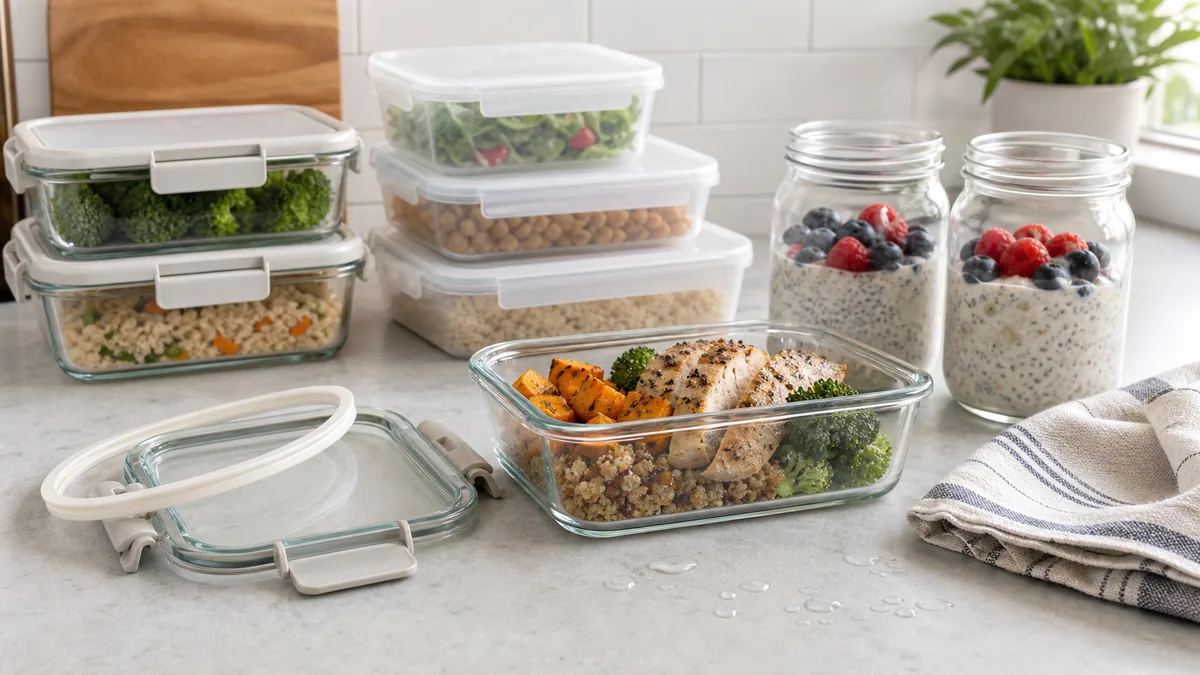
Containers are the one piece of meal prep gear that fails visibly. Lids warp, seals stop sealing, plastic stains orange the first time it meets tomato, and the "leak-proof" one empties itself into your bag on a Tuesday.
We used six sets for eight weeks of ordinary cooking, then ran each through the four things that actually break containers.
#How did we test these containers?
- 40 dishwasher cycles Warping, clouding, lids that stop closing
- 20 microwave reheats Tomato chilli — staining and lid deformation
- 4 weeks frozen −18°C then straight to thaw, checking corners
- 200 ml leak test Lid on, laid flat in a bag, carried all day
#How did they survive the dishwasher?
40 top-rack cycles. We looked for warping, clouding and lids that stopped closing.
#How did they survive the microwave?
20 reheats of tomato-based chilli, which is the harshest realistic test for staining and for lid deformation.
#How did they survive the freezer?
Four weeks at −18°C, then straight to a thaw. We were looking for cracking at the corners.
#Which lids actually stayed sealed?
200 ml of water, lid on, laid flat in a bag and carried for a day.
We bought everything ourselves. Nothing here was supplied by a brand. Full details of how we work are in our editorial policy. Where we quote reheating temperatures, they follow the FDA Food Code.
#Should you buy glass or plastic meal prep containers?
The reason this comes down to material rather than brand is that both failure modes are physical. Plastic stains because tomato's fat-soluble pigments migrate into a porous polymer surface; glass does not stain because there is nothing for them to migrate into. Plastic warps because it softens near the temperatures a dishwasher's drying cycle reaches; glass does not. No amount of marketing changes either.
#What is glass better at?
Not staining, not holding smells, going oven-to-table, lasting years, and food genuinely tasting better out of it. Borosilicate glass handles thermal shock better than soda-lime.
#What is plastic better at?
Weight, price, not shattering, and stacking smaller.
If you carry lunch in a backpack and cycle, plastic. If containers live between fridge and microwave at home, glass. Most people are best served by owning both: glass for home, two or three plastic ones for travel.
#What should you look for in a meal prep container?
#Why four locking clips instead of two?
Two-clip lids bow in the middle and leak. This is the single most reliable predictor of whether a set is still sealing in a year, and the reason is leverage: two clips apply pressure at two points, so the unsupported span in between flexes upward as soon as the gasket stiffens with age. Four clips halve that span.
#Why does the gasket need to come out?
Gaskets trap water and grow mould. If it does not come out, the container has an expiry date.
#Why do tapered containers waste fridge space?
Tapered containers stack beautifully in the cupboard and waste a third of their volume in the fridge.
#What size container suits a main meal?
Smaller and you compress the food; larger and it slides around and dries out.
#Are compartment containers worth it?
For most kitchens, no. Compartment trays sound sensible and are mostly a trap: the dividers are never quite the right size, the sections leak into each other anyway, and they make it harder to store the sauce separately — which, as our storage guide explains, is the single most useful thing you can do to make prepped food last.
#Which container sizes are worth owning?
#How many of each size do you need?
| Size | Use | How many |
|---|---|---|
| 350 ml | Sauces, dressings, snacks | 6 |
| 700 ml | Main lunch portion | 6 |
| 1 L | Grains, roasted vegetables in bulk | 3 |
| Wide-mouth jars, 500 ml | Overnight oats, soups, salads | 5 |
That is the whole kit. Twenty containers covers a household of two comfortably, and buying more than you need is how cupboards become avalanche zones.
#Which containers should you actually buy?
#Buy: glass with four locking clips
For containers that mostly stay at home. Nothing else survives four years of tomato sauce still looking new.
#Buy: polypropylene (marked PP or #5)
For anything that leaves the house. It handles microwave heat without warping, unlike cheaper plastics, and it is light enough to carry.
#Buy: wide-mouth glass jars
For anything liquid or layered. Cheap, they seal properly, and they are the correct container for overnight oats.
#Skip
Compartment trays, anything advertised as "collapsible", anything with a snap lid and no gasket, and any set where the lids are not interchangeable across sizes.
#How do you make containers last twice as long?
#Which five habits matter most?
#How often should you remove the gasket?
Wash both parts separately. This is the whole ballgame for smell — a gasket left in place for a year is why containers start smelling of last month's curry.
#Which dishwasher rack should you use?
The bottom rack sits nearest the heating element and is where lids go to warp.
#Can you microwave with the lid clipped shut?
Steam pressure stretches the gasket permanently. Rest the lid on top instead.
#How do you stop plastic staining orange?
A thin film of oil genuinely prevents the orange staining. It is the only one of these tricks that sounds like folklore and actually works.
#Why does glass crack with boiling liquid?
Let it drop below 80°C first, or you will eventually crack one. The mechanism is thermal shock: the inner surface expands the moment it meets boiling liquid while the outer surface is still at room temperature, and the stress between those two layers is what splits the wall. Borosilicate expands less than soda-lime glass for the same temperature change, which is why it survives the abuse longer — a matter of degree, not immunity.
#What container gear do you not need?
#Which gadgets gather dust?
A vacuum sealer, unless you buy meat in bulk. Silicone bags, which never dry properly. Anything with a phone app. A label maker — masking tape and a marker have never failed anyone.
The containers matter far less than the habit. If your current ones seal and survive the microwave, keep them and spend the money on better ingredients instead.