Freezer Meals That Actually Work (And 9 That Do Not)
Freezing is a texture problem, not a safety problem. Here is what comes out the other side tasting like you just made it, and what turns to mush.
Almost nothing becomes unsafe in a freezer. At −18°C bacterial growth stops entirely, and the USDA's cold storage guidance is that frozen food stays safe indefinitely. What degrades is quality — and quality is why most people's freezer contains three sad containers nobody wants to open.
The reason quality degrades at all comes down to ice crystal size. Water inside food freezes into crystals, and slow freezing gives those crystals time to grow large enough to rupture cell walls. On thawing, the ruptured cells cannot hold their water and it runs out, which is exactly what "mushy" means. Every useful freezing habit below follows from that one fact.
The rule underneath all of it: freezing damages structure, so freeze things that have no structure left to lose.
A stew is already collapsed. A salad is not. That is the entire theory.
#Which meals freeze brilliantly?
#Which cooked dishes freeze well?
Soups, stews, chilli, curry, dal. The gold standard. Many are genuinely better after freezing because the extra time lets flavours settle. 3 months.
Bolognese and other meat sauces. Freeze the sauce, cook the pasta fresh. 3 months.
Cooked beans and lentils. Freeze in the liquid they cooked in. Better than tinned and a third of the price. 3 months.
#Which raw and baked items freeze well?
Raw marinated meat. Freeze raw in the marinade. It marinates while it thaws, which means zero extra work and better meat. 3 months.
Bread, wraps, tortillas. Freeze the day you buy them, not the day before they turn. Toast straight from frozen. 3 months.
Cooked grains. Rice and quinoa freeze fine in flat portions. Reheat with a splash of water. 1 month.
Pesto, herb pastes, stock. Ice cube trays, then into a bag. 6 months.
Muffins, pancakes, waffles. Freeze flat on a tray first, then bag. Straight into the toaster. 3 months.
Uncooked cookie dough. Portioned into balls. Bake from frozen, add three minutes. 3 months.
#Which foods should you never freeze?
#Which foods collapse in texture?
Potatoes in stews. They go grainy and waterlogged. Leave them out, add fresh potato when you reheat.
Cream and milk sauces. They split. Freeze the base without dairy and stir the cream in during reheating.
Cooked pasta in sauce. It keeps absorbing liquid and arrives as paste.
Fried anything. Crispness does not survive. Nothing brings it back.
#Why do dairy and watery foods fail?
Salad, cucumber, celery, lettuce. High water content, no structure afterwards. They turn to liquid.
Whole eggs in shell. They expand and crack. Beaten eggs freeze fine.
Soft cheeses, yoghurt, sour cream. They separate. Hard cheeses freeze acceptably if you will be cooking with them.
Mayonnaise-based anything. Splits irreversibly.
Anything already frozen and thawed once. Refreezing thawed raw meat is both a texture and a safety problem.
#How should you freeze food properly?
#Why must food cool completely first?
Warm food raises the freezer temperature and lets everything around it partially thaw. Follow the cooling rules in our storage guide.
#Why does freezing flat matter so much?
- Cool completely Warm food thaws its neighbours
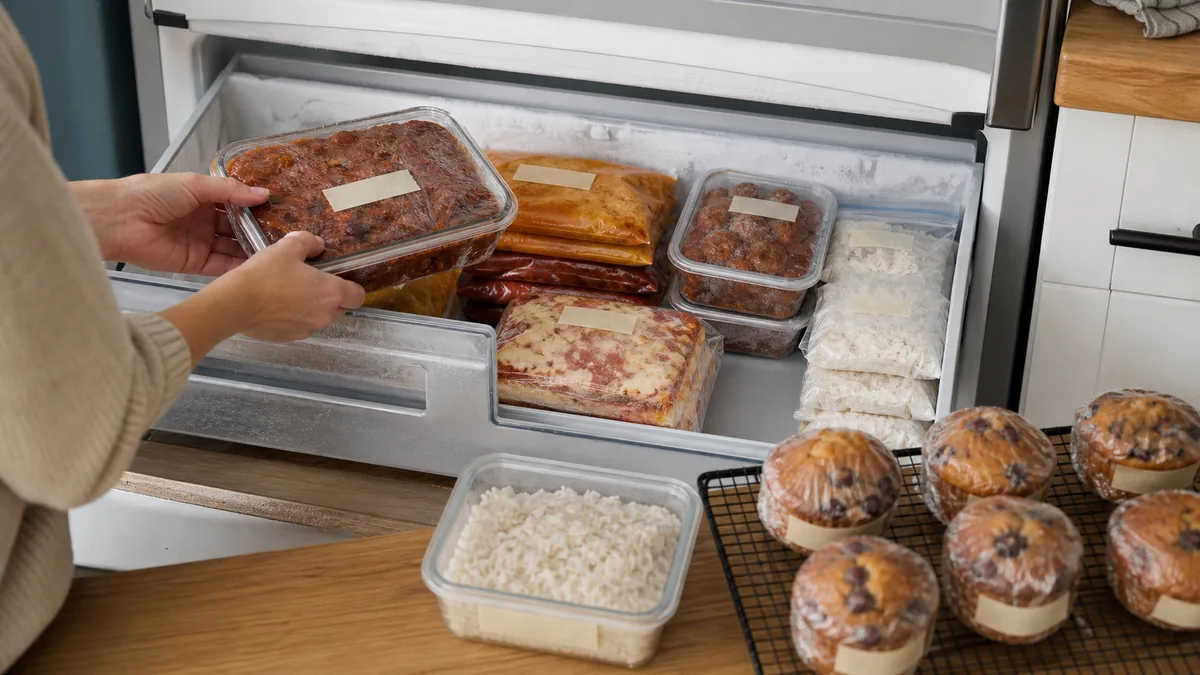
- Freeze flat in bags Faster freeze, smaller ice crystals
- Press the air out Air is what causes freezer burn
- Portion and date A 2 kg block is a commitment
Zip bags laid flat freeze in about a third of the time, stack like files, and thaw far faster than a block in a tub. Faster freezing means smaller ice crystals, which means less texture damage. This is the single biggest quality lever you have.
#How do you prevent freezer burn?
Air causes freezer burn — the dry, grey patches that taste of freezer. Press the air out of bags; leave the smallest possible headspace in tubs, except for liquids, which need 2 cm to expand.
#Should you portion before freezing?
A 2 kg block of chilli is a commitment. Six single portions are a dinner.
#What should the label say?
Everything looks identical after a month under frost. Masking tape and a marker is all it takes.
#How should you thaw and reheat frozen meals?
#Which thawing method is best?
#Best: overnight in the fridge
Slow, safe, minimal texture damage. Move tomorrow's dinner down a shelf tonight and the problem solves itself.
#Fine: straight from frozen into the pan
Works for soups, stews and sauces. Add a splash of water and keep the heat low.
#Acceptable: microwave defrost
Only if you cook it immediately afterwards — defrosting warms the edges well into the danger zone.
#Never: on the counter all day
The outside sits at room temperature for hours while the middle is still solid. This is the classic way to make yourself ill with perfectly good food.
#How hot should reheated food get?
Reheat to steaming hot throughout — 74°C / 165°F if you measure. And reheat once only: the freeze–thaw–reheat–refrigerate–reheat cycle is where most home food poisoning actually starts.
#What should a useful freezer actually contain?
#Why five items beat a full freezer?
Because five things you would actually choose to eat are worth more than thirty you would not. The goal is not a full freezer. It is a freezer with four or five things you would actively choose to eat on a night you cannot face cooking.
#Which five are the default?
A chilli, a dal, a bolognese, a bag of marinated chicken thighs, and some bread.
#How do you keep it topped up?
Add one item back every prep day and the freezer stops being a graveyard and starts being the reason you do not order takeaway.
Our $50 weekly plan produces two of those five as a by-product of an ordinary week.